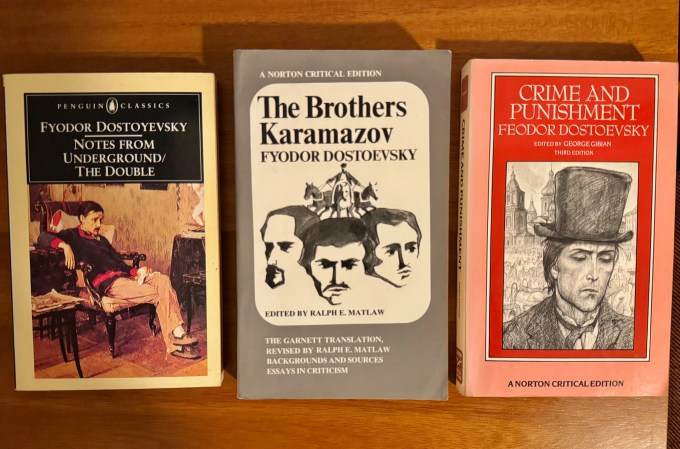
Apparently, college students are no longer capable of reading books. I guess they watched too many TikTok videos or became too dependent on AI summaries, so now they’re morons. I read all about it in The Atlantic.
A college professor I recently met more or less confirmed the declining literacy of today’s youth when I brought up the matter so she’d stop talking about her cats. My husband and I were spending the weekend in Ogunquit, Maine, and our inn hosted a wine-and-snacks thing for guests. We got to talking with this professor, who was a lesbian, so of course she had pet-related drama to share. Seems there was a whole thing with the cat sitter.
And I was like, “Uh-huh, sure, I hear ya, now is it true kids these days are idiots?”
She wouldn’t go that far. But she also wouldn’t go so far as to assign, like, chapter books.
Listen, I didn’t read everything on the syllabus when I was an undergrad, either. There wasn’t always time, what with my busy schedule of listening to the original cast recording of Rent on a loop.
Sometimes, when I had an especially thick tome to get through before a fast-approaching deadline, I’d decide to read only the first sentence of every paragraph. I’ll admit that was a dumb strategy. Why, if you had followed it while reading this post, you would have missed that Rent gag in the preceding paragraph.
I did, however, tend to read assigned works of literature (novels, plays, and poetry) in their entirety—not because I’m conscientious but because it’s pretty easy to get me engrossed in a story when it’s written down. Put it on paper and I might even care about your cat sitter woes.
The literature classes I took weren’t always as interesting as the books, to tell you the truth. Academics have a knack for draining the life out of a good story.
But there were exceptions. For example, a Dostoevsky course I took during my junior year at Northwestern was taught by a professor named Irwin Weil, whose lectures I found gripping. He had a grab-‘em-by-the-lapels enthusiasm for his subject and an exclamatory style of delivery that made Dostoevsky’s novels—each an obsessive ordeal of one sort or another—feel like swashbuckling adventures.
I recall Weil wearing ill-fitting suits and speaking with speed and vigor. You could hear the exclamation points, of which there were many.
According to the Northwestern alumni magazine, Weil died earlier this year. He was 97.
The obit notes, among other things, “the dramatic teaching style for which he became known” and the four decades he spent on the Northwestern faculty, starting in 1966. During that time he “introduced hundreds of undergraduates to Russian literary classics and taught about the contemporary Soviet Union/Russia in his lecture courses, which were among the University’s most popular classes.”
I remember him telling my class that he got into Russian literature when he himself was an undergraduate (at the University of Chicago, according to his university bio). Somebody recommended he read Crime and Punishment. He devoured the novel in one long fevered marathon, and by the time he got to the last page he had decided he had to learn Russian so he could read the text in the original.
Look at what can happen when you crack open a book.

