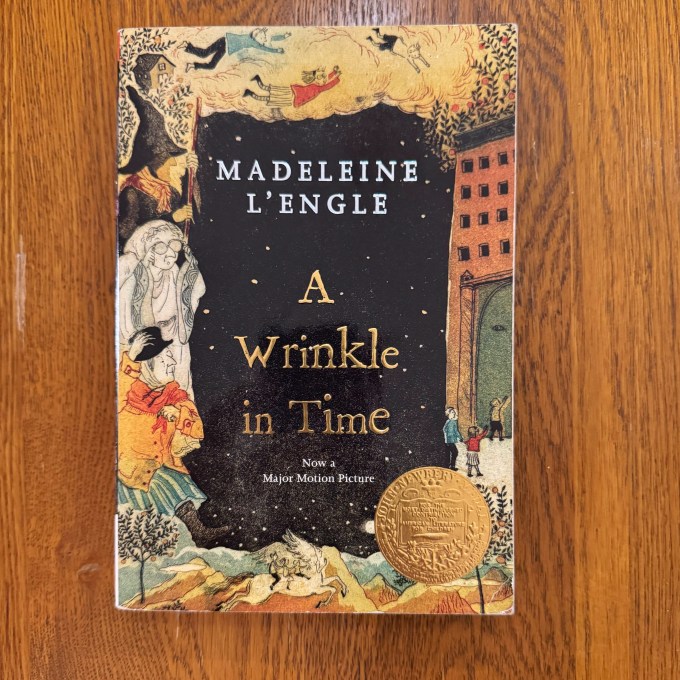
Not long ago, I ran out of reading material during an out-of-town trip, so I dragged my husband, Frank, who was with me, inside the next bookstore we encountered. I asked him to pick out something for me, ‘cause I didn’t have access to my Books to Read lists and was therefore incapable of making a decision.
He selected Madeleine L’Engle’s A Wrinkle in Time, which everyone else my age seems to have read in the fifth grade. I, however, had never gotten around to this particular YA classic, a part woo-woo, part science-y tale involving two young siblings and a friend traveling through time and space in order to rescue the siblings’ father from powerful evil forces.
For much of the novel, I felt like the author was up her own ass with the world-building—all the supernatural creatures and the traveling by tesseract and such. The characters are always saying stuff along the lines of (and I’m paraphrasing here), But Mrs. Whatsit warned us that Camazotz surrendered to the Black Thing!
I kept wanting somebody to be like, “Have y’all noticed how this magical intergalactic odyssey is making us sound like somebody having a mental health emergency on the crosstown bus?”
Still, the part at the end where our flawed and perpetually confused yet plucky heroine, Meg Murry, manages to save the day using her special skill, which turns out to be her capacity to love, did make me cry my eyes out. Course, I was on a plane at the time (coming home from the trip where I ran out of reading material), and I find that people are more likely to weep from books and movies at 30,000 feet.
I believe this theory is supported by scientific evidence and by the time I sobbed through a seat-back screening of My Big Fat Greek Wedding 3.
At any rate, when I read on the back cover of my copy of A Wrinkle in Time that it’s the “first book in Madeleine L’Engle’s classic Time Quintet,” I decided then and there I had to read the other four installments, like some kind of catharsis junkie chasing a weepy fix that will replicate that first cry high.
I have been disappointed, however, by the further adventures of Meg and her family.
After A Wrinkle in Time (1962), the remaining volumes are A Wind in the Door (1973), A Swiftly Tilting Planet (1978), Many Waters (1986), and An Acceptable Time (1989).
Throughout the saga, L’Engle keeps the journeys across time and space coming, along with the attendant mythical creatures and heady scientific concepts. But the sequels lack A Wrinkle in Time’s emotional force, which is rooted in Meg’s relatable vulnerability and sense of feeling overwhelmed by forces beyond her control.
As the series progresses, the characters get duller and the dialogue gets clunkier, while the author’s imagined worlds get increasingly arcane. That’s a terrible combo unless you want to read what feels like hundreds of pages about “kything,” a vague form of telepathic communication practiced by Meg and her insufferably wise kid brother, Charles Wallace. He can go fly a kythe for all I care.
I have slogged my way into the last book, and I intend to see it through because quitting would be letting the Echthroi win. But it’s been a long trip and I’m ready to go home.
 Indirect Objects