Earlier this year I met a reader of this blog who told me my work reminded him of Erma Bombeck. Since I hardly ever write about my experiences as a harried suburban mom, I assume what the reader meant is that he finds me funny. Or maybe witty, which is what you call a funny person who doesn’t actually make you laugh.
When I started Indirect Objects in August 2019, I wanted to explore the workings of time and memory via everyday items and their peculiar power to unlock worlds of feeling. You know: all that Proust-eating-a-madeleine crap.
Six years on, the project has apparently devolved into a semiregular lifestyle column recalling the output of middlebrow newspaper humorists. To quote the celebrated wit (get ready not to laugh) Noël Coward, “I believe that since my life began, / The most I’ve had is just a talent to amuse.”
Incidentally, “humorist” is another useful term when you need to describe an unfunny funny person.
And also: happy sixth anniversary!
Do newspaper humor columnists still exist, by the way? There used to be a bunch of them—Bombeck, Dave Barry, Lewis Grizzard, et al.
In addition to appearing regularly in newspapers across the country, these writers would sometimes release collections of their comical musings in book form. My family owned several such volumes when I was a kid. They always had goofy titles such as If Life Is a Bowl of Cherries, What Am I Doing in the Pits? (by Bombeck), Don’t Bend Over in the Garden, Granny, You Know Them Taters Got Eyes (by Grizzard), and All the World’s a Stage! Stage 4 Pancreatic Cancer, That Is! (made up by me just now).
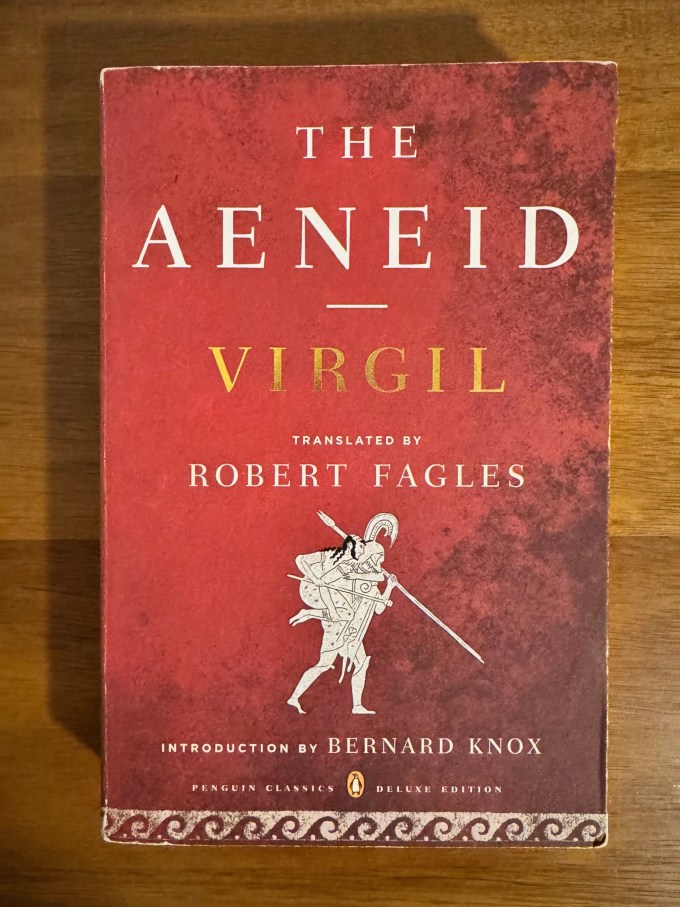
I’d love to dip into one of those books with you sometime. But this is the anniversary post, and tradition dictates that the book into which I dip for the anniversary post is Virgil’s Aeneid. Or, as Erma Bombeck would have titled it, All Roads Lead to Rome, but I Took a Wrong Turn at Albuquerque.
My custom each August, initiated in the very first Indirect Objects entry, is to consult the Virgilian lottery, a form of soothsaying where you open Virgil’s works at random and whatever passage you land on supposedly tells your fortune.
This year, I closed my eyes, cracked open Robert Fagles’s translation of The Aeneid, and pointed at a spot in what might be the most famous part of the poem, Book 4. That’s the one where our hero, Aeneas, gets with and then jilts poor Dido, queen of Carthage, because he has to go invent the Romans or some such (any excuse not to commit, am I right, ladies?).
This year’s fortune-telling passage comes just after Dido has confronted Aeneas as he is trying to sneak away. Having failed to ghost her, he attempts to gaslight her instead.
I’ll state my case in a few words. I never dreamed
I’d keep my flight a secret. Don’t imagine that.
Nor did I once extend a bridegroom’s torch
Or enter into a marriage pact with you.
As you might imagine, I don’t love these lines as a prediction for the year ahead, seeing as how they seem to portend broken promises and heartbreak. I just have two questions:
1.) Am I the Aeneas or the Dido here?
and
2.) Whose bright idea was it to make an oracle of a poem in which so many bad things happen? Try opening The Aeneid at random and not landing on lines about warfare, pissed-off gods, and inconsolable shades in the underworld.
I swear to Jupiter, next year I’m gonna seek my destiny in the pages of The Grass Is Always Greener Over the Septic Tank.
 Indirect Objects