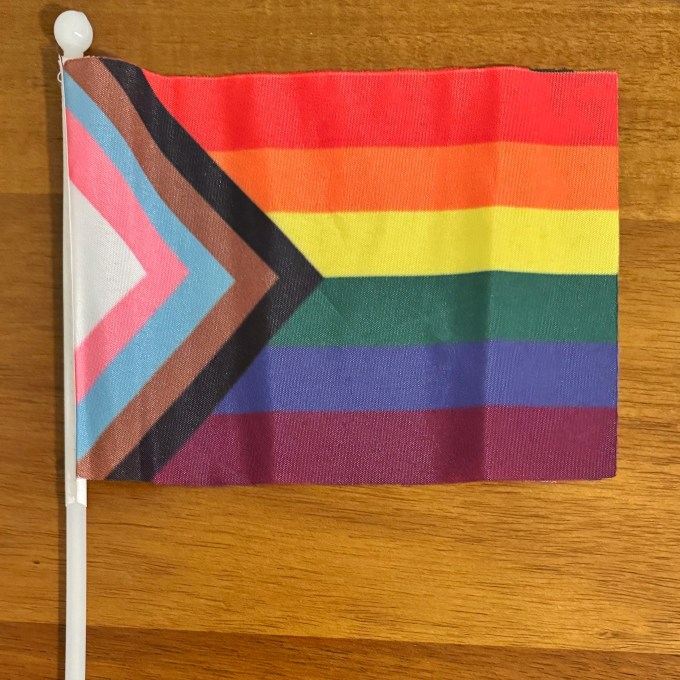
I’ve been attending Pride parades since the early 2000s. That amounts to a quarter century’s worth of June Sundays spent standing around in the hot sun and squinting at go-go boys on floats.
To tell you the truth, I have never exactly found the spectacle riveting. I don’t blame the LGBTQ+ community. Time and again we have proven ourselves adept at putting on shows, from Broadway musicals to the Easter pageant at any given small-town church.
The trouble is the parade format itself—overlong, repetitive, and poorly paced almost by definition. Really, a parade of any kind is one of those things that’s supposed to be entertaining but is actually quite tedious. Like a drum solo. Or the third season of The White Lotus.
On two occasions during that 25-year run, I have been a part of the parade—once in Chicago and once in New York City.
For the former event, I rode on the float for the Chicago Reader, an alt-weekly I contributed to at the time. The float had a banner that said, “We come out every Thursday!”
I recall feeling drunk with power on account of how badly the parade’s spectators wanted the cheap beaded necklaces I was distributing. I also recall feeling drunk with alcohol because there was nothing to do but day-drink in the long hours while we we sat on the float and waited to get going. I had to pee the entire length of the route.
“Today I feel more like a brand than a person,” Christopher Soto writes of Pride in a poem called “Queer Liberation.” “Sometimes I wish Marsha P Johnson could spit on these gays / Then I wonder if she would spit on me too”
This year, though, it’s possible that Pride could regain some of the old subversive fighting spirit. For one thing, there will be fewer corporate sponsors, owing to the cowardice of companies afraid to appear in favor of diversity, equity, and inclusion—heaven forfend!—in front of Donald Trump and his followers.
Trump’s rollback of LGBTQ+ rights, especially with regard to trans folks, certainly merits a show of opposition. As the New York Times reports, “The president has issued executive orders that bar transgender people from serving in the military, restrict gender identities on travel documents and proclaim that it is U.S. policy to ‘recognize two sexes, male and female,’ that are ‘not changeable.’”
Beyond Trump, several other recent trends have put we gays on the defensive, such as anti-queer book bans, the Southern Baptists gunning for same-sex marriage, and Patti LuPone being an asshole to Audra McDonald.
Surrounded by this atmosphere of gloom, I’d say a display of joy and righteous fury is exactly what we need.
Both of those elements were present during the 1969 Stonewall Uprising that helped kick off the modern LGBTQ+ movement, according to a depiction of the protests written by novelist Edmund White, who was a witness. (White died at age 85 on June 3).
In The Beautiful Room Is Empty (1988), White describes the ambience of the rebellion as a chaotic mix of property damage, political chanting, and wisecracks. “This could be the first funny revolution,” someone says.
Amid the laughter and the solidarity, the narrator feels ridiculous but also “giddily confident.” “I caught myself foolishly imagining that gays might someday constitute a community rather than a diagnosis,” he recalls.
Ultimately, that sentiment suggests to me the best reason for attending Pride—to protect and promote a community that some seem hell-bent on undoing.
And so I’ll be there again this year. Tedious parade notwithstanding.
Happy Pride.
 Indirect Objects